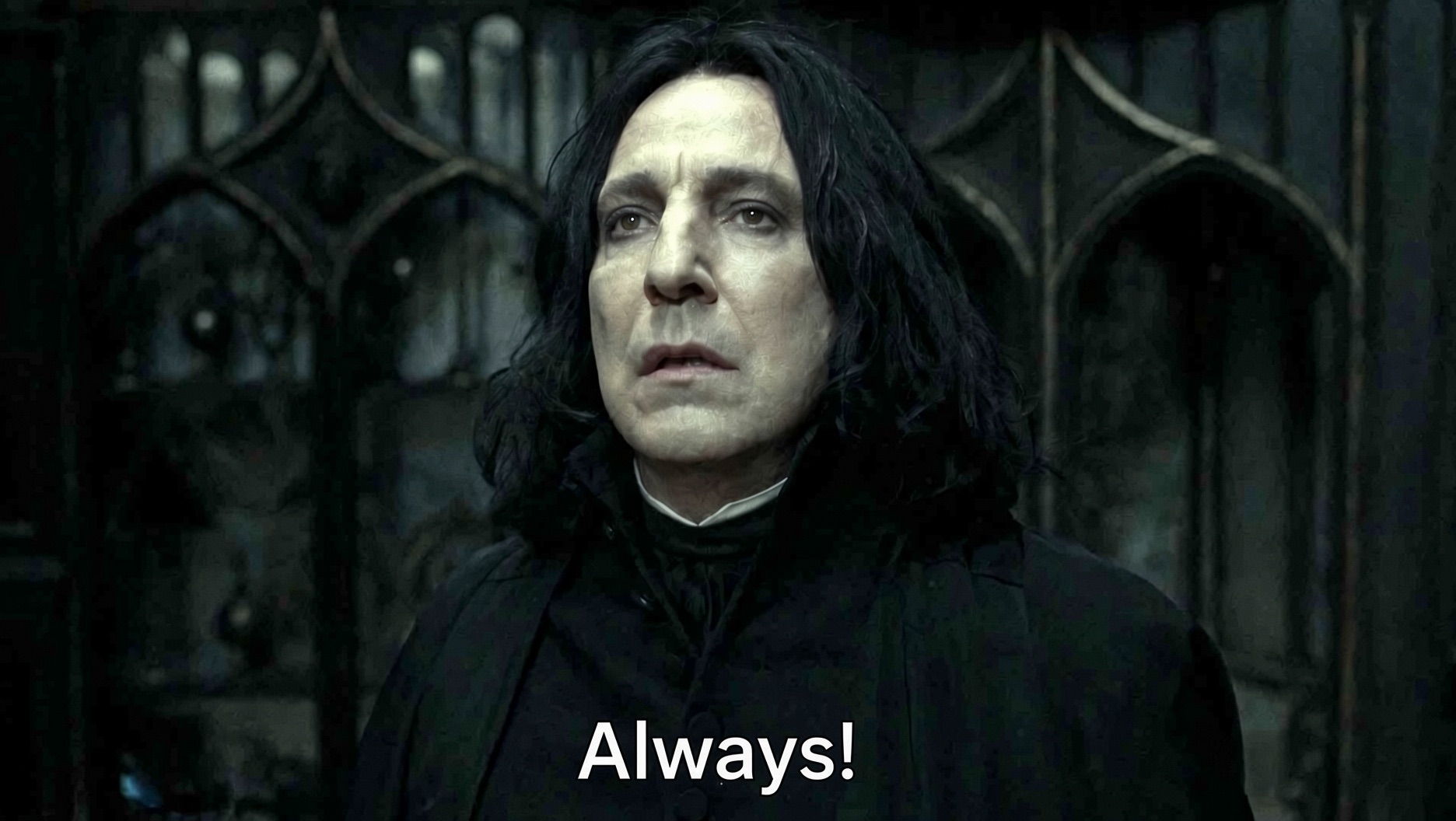
Few moments in the Harry Potter series have been turned into a cultural shorthand quite like Snape’s “Always.” It has become synonymous with eternal love, tragic romance, and the idea that Severus Snape was secretly a good man all along. But for readers who go back through the books rather than relying on the film version or the countless social-media edits, the scene is much more complicated. Rowling doesn’t give us a simple redemption story in which Snape’s love for Lily magically makes all of his previous behavior acceptable. Instead, she gives us a character whose capacity for courage exists alongside bitterness, cruelty, regret, obsession, and genuine self-sacrifice.
That distinction matters because Snape is one of the few characters whose moral complexity actually survives the final revelation. The Pensieve sequence in Harry Potter and the Deathly Hallows doesn’t ask us to forget what we know about him. It asks us to reinterpret it.
“Always” Is About More Than Romance
The scene in the Headmaster’s office is deceptively short. Dumbledore asks Snape whether, after all this time, he still cares. Snape produces his Patronus—a silver doe, identical to Lily’s—and answers, “Always.”
On the surface, it is a devastatingly romantic moment. But the context surrounding it makes the word considerably heavier. Snape’s Patronus is not merely evidence that he loved Lily Evans. It represents the fact that Lily’s death has become the central emotional event of his adult life. His feelings have not faded with time; instead, they have become intertwined with guilt, responsibility, and the promise he made to protect her son.
That’s why reducing “Always” to a love quote misses something important. Snape isn’t simply saying, “I still love her.” He’s demonstrating that the decision he made after Lily’s death has never changed. He is still committed to the mission that began with his guilt over his role in the events that led to her death. He has spent years maintaining that commitment, even though almost everyone around him believes he is either a coward, a bully, or a Death Eater.
The tragedy is that Snape’s love for Lily is both the source of his redemption and evidence of how emotionally trapped he has become.
Snape’s Story Actually Begins With a Terrible Mistake
One of the most important details in understanding Snape is that his transformation doesn’t begin because he suddenly develops a sophisticated moral objection to Voldemort’s ideology. It begins because his own actions have catastrophic consequences.
As a young man, Snape becomes involved with the Death Eaters and embraces at least some of the prejudices that surround Voldemort’s movement. He also becomes fascinated with Dark Magic. During this period, his friendship with Lily has already deteriorated badly, and the two end up on opposite sides of an increasingly dangerous political divide.
Then Snape overhears part of Sybill Trelawney’s prophecy and reports what he hears to Voldemort. He doesn’t know exactly who the prophecy concerns, but Voldemort interprets it as referring to the child of James and Lily Potter.
When Snape realizes Lily is in danger, he goes to Dumbledore.
This is the point where his story becomes morally complicated. Snape is horrified by what Voldemort intends to do, but his initial request is specifically about Lily’s safety. He asks Dumbledore to protect her. He isn’t suddenly thinking about the broader consequences of Voldemort’s ideology or the danger facing an entire generation of witches and wizards.
His motivation is personal.
He wants Lily to live.
That doesn’t make the feeling meaningless. Quite the opposite. It makes his eventual transformation much more believable because it begins with a profoundly personal form of guilt.
Snape Never Becomes the Person Lily Wanted Him to Be
This is one of the reasons the popular “Snape was secretly good all along” interpretation doesn’t quite work.
Lily herself had already seen the uglier side of Snape long before she died. Their friendship deteriorated partly because of his growing association with people who embraced pure-blood ideology and because of his interest in Dark Magic. Most importantly, Snape eventually calls Lily a “Mudblood” during the infamous confrontation with James and Sirius.
He immediately regrets it, but the damage is done.
This matters because Lily isn’t sitting somewhere in the afterlife thinking, “Severus was a wonderful person who was misunderstood.” The memories we see suggest something much more tragic: Snape loved someone whose values he repeatedly failed to live up to.
Lily believed in things that Snape struggled to embody. She valued friendship and compassion; Snape increasingly surrounded himself with people who valued blood status and power. She eventually chose James, despite his own flaws, while Snape remained consumed by resentment toward him.
So when Lily dies, Snape doesn’t simply lose the love of his life.
He loses the person who represented the possibility of becoming someone better.
That is a much more painful interpretation of his story.
Harry Is the Living Contradiction Snape Can’t Escape
This is also why Snape’s relationship with Harry is so important.
Harry is Lily’s son, but he is also James Potter’s son.
Every time Snape looks at Harry, he sees the boy who has Lily’s eyes and James’s face. Harry is therefore both a connection to the person Snape loved and a constant reminder of the person he hated.
This explains some of Snape’s hostility, but it doesn’t excuse it.
That’s an important distinction that the books allow us to make. Snape’s trauma and resentment help explain why he treats Harry so unfairly, but Harry is still a child who has done nothing to deserve the hatred directed toward him.
The same applies to Neville. Snape’s treatment of Neville is particularly revealing because Neville has nothing to do with Snape’s relationship with Lily or James. His fear of Snape is real, and Snape’s behavior toward him is cruel. Whatever else Snape accomplishes, we shouldn’t pretend those scenes never happened simply because we later learn about his role as a spy.
That is precisely why Snape works as a character.
His heroism doesn’t erase his cruelty, and his cruelty doesn’t erase his heroism.
Both are true.
The Patronus Is the Real Revelation
The doe Patronus is one of the cleverest pieces of symbolism in the entire series because it communicates something Snape never says directly.
A Patronus is deeply connected to a person’s identity and emotional life. Lily’s Patronus is a doe, and Snape’s eventually becomes the same.
The implication is not subtle: Lily remains central to Snape’s emotional identity even years after her death.
But notice what the Patronus does not tell us.
It doesn’t tell us that Snape is morally pure.
It doesn’t tell us that Lily would have forgiven him.
It doesn’t tell us that his past no longer matters.
It tells us that his feelings never disappeared.
And those feelings become the foundation for one of the most difficult forms of sacrifice in the series: Snape agrees to become someone almost everyone will hate in order to maintain his position close to Voldemort.
Snape’s Greatest Achievement Wasn’t Dying
It’s tempting to say that Snape’s heroic moment is his death.
But arguably, his greatest achievement happens over the seventeen years before it.
He has to maintain an almost impossible deception.
Voldemort is extraordinarily suspicious. He is also capable of using Legilimency and has little hesitation about killing anyone he believes has betrayed him. Snape therefore can’t simply tell a few people the truth and expect everything to work out.
He has to behave like a Death Eater.
He has to allow people to believe he’s a Death Eater.
He has to make decisions that look suspicious.
He has to remain close enough to Voldemort to provide useful information.
And eventually, after Dumbledore’s death, he becomes Headmaster of Hogwarts while the school is effectively under Death Eater control.
From the outside, it looks like Snape has finally revealed his true allegiance.
For much of Deathly Hallows, Harry believes exactly that.
And Snape knows that the truth cannot be revealed without potentially destroying the entire operation.
That’s an enormous psychological burden.
The Murder of Dumbledore Changes Everything
Snape killing Dumbledore is one of the reasons the “Always” revelation is so effective.
At the end of Half-Blood Prince, Harry is convinced Snape has betrayed Dumbledore. From Harry’s perspective, the evidence is overwhelming: Snape uses the Killing Curse and Dumbledore dies.
But we later discover that the two men planned it.
Dumbledore is already dying because of the curse associated with Marvolo Gaunt’s ring, and he knows Voldemort has ordered Draco to kill him. Dumbledore’s plan is for Snape to perform the killing instead, partly to protect Draco and partly to preserve Snape’s position within Voldemort’s ranks.
This is where Snape’s double life becomes genuinely dangerous.
He isn’t merely pretending to be evil.
He has to commit acts that make the people on his own side hate him.
The success of the mission depends on everyone believing the lie.
And Snape is good enough at it that Harry doesn’t understand the truth until after his death.
But Even Dumbledore Doesn’t Let Snape Off Easily
There’s another important detail that gets lost in the romantic interpretation of Snape.
Dumbledore doesn’t treat Snape’s love for Lily as proof that he has become morally perfect.
Their relationship is often tense.
Dumbledore understands Snape’s motivations, but he also recognizes the selfishness and bitterness beneath them. One of the most revealing moments is when Dumbledore challenges Snape over his willingness to protect Harry only because he is Lily’s son.
When Snape asks why Dumbledore has kept Harry alive, Dumbledore points out that Snape has effectively been protecting him because of Lily.
Snape’s response is essentially that he has done it for a long time.
Dumbledore then forces him to confront the implication of that attitude.
This is important because Snape’s protection of Harry gradually becomes something larger than simply preserving Lily’s memory.
He eventually protects Harry because it is necessary to defeat Voldemort.
But the original motivation is undeniably personal.
Snape’s Love Is Not Necessarily Healthy
This is where discussions about Snape become uncomfortable.
We often use the language of romantic devotion to describe his feelings for Lily, but the books give us plenty of reason to question whether those feelings should be idealized.
Snape never gets the chance to build a life beyond Lily.
He doesn’t form another great relationship.
He doesn’t find peace.
He doesn’t reconcile himself with James.
He doesn’t stop being bitter.
Instead, he carries his attachment to Lily for decades.
That can be interpreted as devotion, but it can also be interpreted as emotional stagnation.
Snape’s entire identity becomes organized around something he lost.
He isn’t simply remembering Lily.
He is living through her memory.
That’s beautiful in one sense.
But it’s also profoundly sad.
The Snape We Meet at Hogwarts Is Still Real
One of the easiest mistakes is to assume that the Snape revealed in the final book is the “real” Snape and the unpleasant teacher we met earlier was simply an act.
It wasn’t.
Snape really is cruel.
His anger toward Harry is genuine.
His resentment toward James is genuine.
His contempt for Neville is genuine.
His bitterness is genuine.
His commitment to protecting Harry is also genuine.
There isn’t a contradiction here.
Snape is capable of being all of those things at once.
That’s what makes the character so compelling.
If Rowling had revealed that every nasty thing Snape did was merely part of his cover, the twist would actually be weaker. Instead, the revelation forces us to hold two versions of him in our heads simultaneously.
The man who bullied children and the man who risked his life to defeat Voldemort are the same person.
Neither version cancels out the other.
Why Harry Eventually Forgives Him
Harry’s decision to name his son Albus Severus is one of the most debated choices in the epilogue.
Some readers think it makes perfect sense.
Others believe Harry would never have honored someone who treated him so badly.
But Harry’s relationship with Snape changes once he sees the memories.
For the first time, Harry understands that Snape’s behavior was part of a much larger story. He learns that Snape was protecting him, that he had been working against Voldemort, and that Dumbledore trusted him with an extraordinarily dangerous mission.
Harry doesn’t have to decide that Snape was a good man in every respect.
He only has to recognize that Snape was brave.
And that is exactly what Harry tells his son: Severus Snape was “probably the bravest man I ever knew.”
That wording is significant.
Harry doesn’t say Snape was the kindest.
He doesn’t say Snape was the best teacher.
He doesn’t say Snape was a good person.
He says he was brave.
Harry is capable of acknowledging Snape’s courage without pretending his flaws never existed.
So What Does “Always” Actually Mean?
Perhaps the best interpretation is that “Always” represents the entire contradiction of Snape.
It means he never stopped loving Lily.
It means he never abandoned the promise he made after her death.
It means he accepted a life in which he would probably never be understood.
But it also represents the tragedy of someone who never escaped his past.
Snape’s love for Lily saves lives.
It also consumes him.
His guilt motivates him to fight Voldemort.
His bitterness makes him cruel to innocent children.
His courage makes him invaluable to the resistance.
His obsession prevents him from moving on.
That is why turning “Always” into a simple declaration of romantic devotion misses the point.
The Real Tragedy of Severus Snape
Snape’s story isn’t powerful because he was secretly a saint.
It’s powerful because he wasn’t.
He was a deeply flawed man who made a terrible choice when he was young, realized the consequences too late, and spent the rest of his life trying to compensate for them.
He never gets Lily back.
He never gets the life he might have had.
He never receives public recognition.
He never gets to explain himself to Harry.
He never sees Voldemort defeated.
And he never learns that Harry eventually understood what he had done.
The final irony is that the person Snape spent years protecting only learns the truth after Snape is gone.
Harry gets the memories.
Snape gets no absolution.
And perhaps that’s why the final “Always” remains so powerful.
It isn’t proof that Snape was secretly perfect.
It is proof that he chose to carry his guilt and his promise for the rest of his life.
For some readers, that’s heroic.
For others, it’s tragic.
For most serious Potterheads, it’s probably both.
And that’s the point.
Snape isn’t a character who becomes good at the end.
He’s a character who spends his entire adult life trying to do something good despite the fact that he remains deeply flawed.
So when Dumbledore asks, “After all this time?”
And Snape answers, “Always,”
the real question isn’t simply whether he still loved Lily.
It’s whether a person can spend a lifetime trying to atone for one terrible mistake without ever becoming a completely different person.
Harry Potter’s answer seems to be yes.
And that’s what makes Severus Snape one of the most fascinating—and most misunderstood—characters in the entire series.